The AI trade unwinds into a correction
From this brief $64.6 billion
The S&P 500 fell 3.70% into a correction as the AI trade unwound worldwide — Tokyo and Seoul lost more than 5%, Europe followed, and only…
We keep you briefed.
The settled edition · No intraday noise
Market Briefer
The Global Day · Fri Nov 20, 2026
The S&P 500 fell 3.70% into a correction as the AI trade unwound worldwide — Tokyo and Seoul lost more than 5%, Europe followed, and only Mumbai's banks closed higher, while the 10-year Treasury yield fell back below 5% to 4.91%.
The Number That Matters
4.91%
10-year Treasury yield
That is where the 10-year Treasury yield closed on Friday, down 14 basis points and back below 5% for the first time this week. It is the key number because of what it failed to do: a fall of that size in the discount rate would normally slow an equity selloff, and instead technology shares fell 7.27%, which tells us the pressure is not the cost of money but the prices investors will no longer pay for AI earnings that have not yet arrived. It matters more than the headline fall because it separates a valuation unwind from a rates shock, and the two have very different paths from here. A VIX close above 40 would make volatility itself the more important signal.
Key takeaways
The assumption that carried markets all year — that artificial intelligence spending would support every price attached to it — broke on Friday, on a day when almost everything that usually cushions a fall, from lower Treasury yields to a better consumer reading, failed to slow it. The break travelled in sequence: Tokyo and Seoul each lost more than 5% before Europe opened, Frankfurt and Paris followed the same trade lower, and only Mumbai, carried by its banks, closed the day higher.
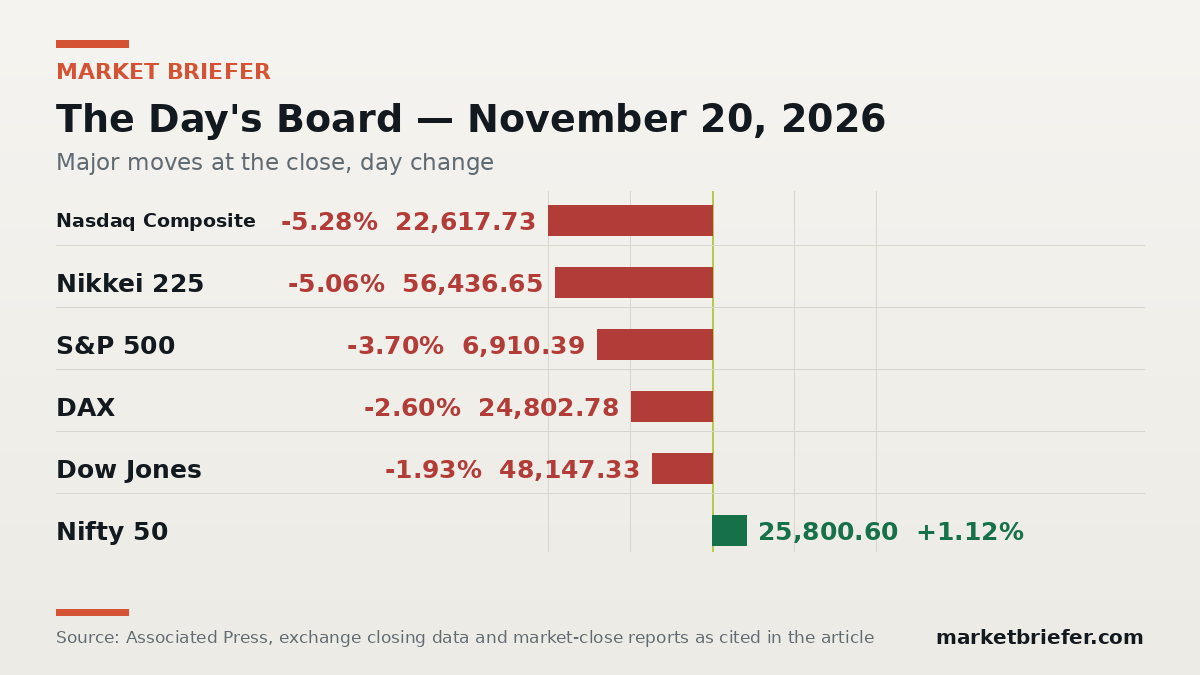
U.S. stocks fell sharply for a seventh straight session. The S&P 500 fell 265.44 points, or 3.70%, to 6,910.39, a close that leaves the index 11.6% below its October 6 record close of 7,819.04 and inside what investors call a correction, according to the Associated Press. The Nasdaq Composite fell 1,261.47 points, or 5.28%, to 22,617.73, erasing its gains for 2026, while the Dow Jones Industrial Average fell 949.73 points, or 1.93%, to 48,147.33. The VIX rose about 26% to 35.89. The seven-day losing streak is the S&P 500’s longest since the onset of the pandemic in 2020, and its weekly loss was its largest since April 2025; the index’s last correction came in March 2025, on the trade-war shock.
The selling centred on the chip trade and then widened. Nvidia fell 13.8%, its ninth decline in ten sessions, amid reports that SEC enforcement staff are examining potential accounting issues at the company: Micron Technology fell 13.9%, Advanced Micro Devices 13.3% and Broadcom 12.1%, taking the PHLX Semiconductor Index down 10.7%. Anthropic, a day after the largest initial public offering on record, fell 9.1% to $88.30, still above its $83 offer price. The day’s data, by contrast, improved: the University of Michigan’s final November consumer sentiment index rose to 51.5 from 48.0 in October, and one-year inflation expectations fell to 3.7% from 4.7%. The survey also showed who a correction reaches first: households with the largest stockholdings reported deteriorating finances even as middle- and lower-wealth households reported improvement. Readers can follow the full board on our markets desk.
The Number That Matters: 4.91%. That is where the 10-year Treasury yield closed on Friday, down 14 basis points and back below 5% for the first time this week. It is the key number because of what it failed to do: a fall of that size in the discount rate would normally slow an equity selloff, and instead technology shares fell 7.27%, which tells us the pressure is not the cost of money but the prices investors will no longer pay for AI earnings that have not yet arrived. It matters more than the headline fall because it separates a valuation unwind from a rates shock, and the two have very different paths from here. A VIX close above 40 would make volatility itself the more important signal.
In the United States, only one of the eleven S&P 500 sectors closed higher: consumer staples, up 0.67%, as General Mills rose 3.7% and Walmart added 1.51% a day after raising its full-year forecast. Health care came closest to flat, down 0.12%. At the other end, technology fell 7.27%, industrials 3.09% and consumer discretionary 2.95%. Outside the chip complex, the movers were the AI buildout’s second line: Corning fell 10.9% and Bloom Energy 15.3%, while UnitedHealth rose 2.83% on a broker upgrade. Policy added a second uncertainty when President Trump said U.S. companies could face restrictions or a substantial tax penalty for building data centres abroad — a threat, not yet a framework, but one that lands directly on the spending plans the market spent the day repricing.
We read this as a correction with a specific cause rather than a verdict on the economy. The consumer data improved, yields fell, and defensive shares were bought, not sold; what was repriced was a single, crowded assumption about how much AI spending is worth before it produces earnings. That matters for borrowers and companies planning investment, because a valuation unwind in one sector does not tighten credit the way a rates shock does — not while credit markets stay as calm as they remained on Friday.
Europe had no offset of its own. The pan-European STOXX 600 fell 1.68% to 627.68, Germany’s DAX fell 661.03 points, or 2.60%, to 24,802.78, France’s CAC 40 fell 152.99 points, or 1.89%, to 7,927.75, and London’s FTSE 100 fell 106.34 points, or 1.02%, to 10,346.34, with technology the weakest sector in each market — STMicroelectronics fell nearly 11% in Paris and Infineon 7.6% in Frankfurt. Europe’s own data pointed the other way on policy: German producer prices rose 8.1% year on year in October, the fastest pace since February 2023, even as British retail sales rose a stronger-than-expected 0.7%.
Asia, trading first on New York’s Thursday reversal, took the day’s largest falls. Japan’s Nikkei 225 fell 3,007.56 points, or 5.06%, to 56,436.65, with SoftBank Group, which has committed about $64.6 billion to OpenAI, down about 16%. South Korea’s Kospi fell 267.93 points, or 5.21%, to 4,869.96, and Taiwan’s Taiex fell 6.63% to 35,877.63, completing its worst week since 1990. Hong Kong’s Hang Seng fell 436.59 points, or 1.91%, to 22,405.03, China’s CSI 300 fell 30.27 points, or 0.76%, to 3,954.57, and Australia’s S&P/ASX 200 fell 137.80 points, or 1.58%, to 8,592.60. China’s central bank held its loan prime rates for an eighteenth month, and Japan’s core inflation accelerated to 2.2% in October. India was the day’s exception: the Nifty 50 rose 286.30 points, or 1.12%, to 25,800.60, its highest close since February, as bank shares carried the index — the Nifty Bank closed at a record 64,635.20, up 2.49% — on continued foreign fund inflows, according to Press Trust of India reporting.
Treasuries were bought through the session and the front end led: the 2-year yield fell 13 basis points to 4.65% and the 10-year fell 14 basis points to 4.91%, even after Federal Reserve Governor Lisa Cook argued for tighter policy during the day. The Dollar Index was little changed at 103.90. The euro held at $1.0990, sterling at $1.3125, and the yen strengthened, with the dollar down 0.83% at 158.64 yen. In credit, the latest ICE BofA spreads available through FRED, for November 19, widened to 94 basis points for investment-grade debt and 352 basis points for high-yield — wider on the week, but levels that describe repricing, not a funding problem. The day’s largest corporate debt news made the same point from the other side: SpaceX sold $32 billion of bonds to finance AI chip purchases, its largest tranche of about $25.2 billion priced to yield 8.259%, against an average high-grade yield of 5.95% on Thursday, according to Bloomberg reporting — capital is available for the AI buildout, at a price that now charges properly for its risk.
Oil rose against the tape. December WTI settled at $83.62 a barrel, up 0.49%, and January Brent settled at $92.57, up 0.64% from Thursday’s $91.98 settlement for the same January contract, supported by continued tension near the Strait of Hormuz; our oil prices explainer sets out how that risk is priced. Gold, unusually, offered no shelter: it fell about 3% to $3,517.24 an ounce at the U.S. close, leaving the metal near fourteen-month lows. Crypto moved with equities, only further: bitcoin fell 4.76% to $58,955, through the $60,000 level, and ether fell about 7.6% to near $1,622 in late trading.
What Would Change This Read: This interpretation would weaken if the 10-year yield closes back above 5.05% while technology shares continue to fall and high-yield spreads widen past 400 basis points, suggesting a broader tightening of financial conditions rather than a contained repricing of one trade. In particular, watch Wednesday’s October PCE reading against the yield, because it would distinguish between the current interpretation — investors repricing AI valuations while the economy and credit hold — and the alternative that inflation is forcing a policy path the whole market has to reprice.
What to watch next week begins on Monday, when Asia reopens with Japan on a bank holiday, followed by flash purchasing managers’ surveys for the United States, the eurozone and Britain, and the start of options trading in Anthropic. Tuesday brings Conference Board consumer confidence and earnings from Dell and Analog Devices. Almost everything else lands on Wednesday, ahead of Thanksgiving: the October PCE price index, the Fed’s preferred inflation gauge, with core prices expected to rise 0.3% on the month, alongside the second estimate of third-quarter GDP, durable goods orders, jobless claims and the Fed’s Beige Book. U.S. markets are closed on Thursday for Thanksgiving and close early on Friday.
This is not investment advice. The Global Close is AI-assisted market research produced with automated data checks; figures are verified against market-close reports and the site’s delayed data feeds at publication time.
The House Read
We read this as a correction with a specific cause rather than a verdict on the economy. The consumer data improved, yields fell, and defensive shares were bought, not sold; what was repriced was a single, crowded assumption about how much AI spending is worth before it produces earnings. That matters for borrowers and companies planning investment, because a valuation unwind in one sector does not tighten credit the way a rates shock does — not while credit markets stay as calm as they remained on Friday.
What would change this read: This interpretation would weaken if the 10-year yield closes back above 5.05% while technology shares continue to fall and high-yield spreads widen past 400 basis points, suggesting a broader tightening of financial conditions rather than a contained repricing of one trade. In particular, watch Wednesday's October PCE reading against the yield, because it would distinguish between the current interpretation — investors repricing AI valuations while the economy and credit hold — and the alternative that inflation is forcing a policy path the whole market has to reprice.
Settled changes · city by city
All changes are settled closes from Fri Nov 20, 2026. Every level is shown with its change.
How deep is the correction?
The S&P 500 closed Friday at 6,910.39 — −11.6% below its October 6 record close of 7,819.04.
Record 7,819.04 · October 6Now 6,910.39
From this brief $64.6 billion
The S&P 500 fell 3.70% into a correction as the AI trade unwound worldwide — Tokyo and Seoul lost more than 5%, Europe followed, and only…
From this brief $582.3 million
Bitcoin fell 5.14% to $58,955 in Market Briefer's delayed snapshot, breaking below $60,000 for the first time since July, as U.S. spot Bitcoin ETFs recorded $582.3…
From this brief $2 trillion
Anthropic opened at $111.50 and closed at $97.17 in the largest IPO on record, but the S&P 500 fell 2.02% for a sixth straight loss as…
One workaround transfers a seller's low rate to a buyer; the other cuts your payment without touching your rate. How each works and costs.
From this brief $2.15 billion
Diamondback Energy said Nov. 16 it will acquire certain Double Eagle subsidiaries for $2.15 billion in cash and 15.56 million shares, a deal Reuters valued at…
From this brief $43.4 billion
Home Depot has appointed CFO Richard McPhail as CEO effective November 23, 2026, with Ann-Marie Campbell as president and COO and Jordan Broggi as CFO, as…
From this brief $3 billion
Honda will invest $3 billion in a new central Ohio auto plant creating more than 2,000 jobs and capacity for 240,000 more vehicles a year, with…
Airlines, aircraft, and airports — the trade-and-travel economy.
Shipping, ports, and freight — the market that moves the market.
Energy, sovereign investment, and real estate — business across the region.
Sectors named in the settled record
Housing watch
One workaround transfers a seller's low rate to a buyer; the other cuts your payment without touching your rate. How each works and costs.
North America
Europe
Middle East
Asia
Energy leads · the Household weekly brief lands
Technology leads · one rotating brief from the desks
Aviation and Logistics share the day
Real Estate leads, on the week’s verified numbers
Money & Banking leads · The Week Ahead lands
Stocks — the Global Close, after the bell
Subscribe
Markets, briefed. What moved, why it matters, and what to watch next — every weekday morning. Free.
The month in markets, in depth — a cover feature drawn from the month’s Global Closes, the month in published data, and the best of the library, in one designed edition. Not another brief: the month, kept.
Read the editionEvery figure is a settled close — nothing intraday, estimated, or carried over from a previous session. Where the record is silent, the page says so instead of filling the space.
Every figure on this page traces to a named source — a market-close report, a company filing, or a primary document — and is checked again at publication time.